Showing posts with label japan. Show all posts

Joy to Havingsta Starting Pop Selection Up

Thursday, May 06, 2010

I have a regret from my trip to Japan: I let a lot of good Engrish pass me by. There was just so much of it that I became complacent, but now, looking at the meager five Engrish images I did collect, I wish I would've snapped more of the dozens of prime examples I saw.

For those not yet in-the-know, the term "Engrish" refers to words and phrases that have been translated to English by some Japanese person who doesn't quite have a grasp of the language, with amusing results.

A classic example. So profound!

I wonder if they have a term for the opposite... When I spoke Japanese to natives I was always tempted to ask them if I was pronouncing my words quite as well as I thought I was.

So, yes, anyway... Engrish amuses me, and I'm happy to be able to finally contribute some decent examples to the internet world.

Metting of fate
From a WeGo catalog.
Bonus: Urban Dictionary defines metting as
"The act of trying to talk while on illicit drugs."

Michigan State's Mind Academy
Another from WeGo. Actually, their whole online store is just a
treasure trove of stuff like this.
There was a lot of stuff like this just everywhere--Engrish shirts
designed to resemble university clothing. We also saw American
high school class rings on sale for thousands of yen (like hundreds of dollars).

SEXY FIGHT!
I posted this one in my picture post a couple of days ago.
So sue me; it's beautiful. I cropped it up though. Poncho
ran after this guy (yes, guy) to get this shot.

The Space Where it was Satisfied
Poncho picked up this shirt in Harajuku. It was difficult
narrowing down which shirt to take home, there were so
many amusing choices.

Seduction
Joy to Havingsta Starting Pop Selection Up
And this is the one I got in Harajuku. I'm in love with my own T-shirt.
It makes no sense and is adorable. The back is also adorable.

If you'd like to absolutely bathe in Engrish, Engrish.com is the place to be. They've been at this for years.

Japan in Two Dozen Pictures

Tuesday, May 04, 2010

I have somehow managed to narrow down my 1,100+ photos from Japan down to twenty four. These represent the best of what I saw during my time in Tokyo and Kamakura. I'm already trying to plot out when I can go again. Traveling to other places suddenly seems less important.

Everything I researched and posted before going pretty much holds true. We did end up spending far less than expected on food, and far less than feared on train travel. Train travel for seven days between Narita Airport, all over Tokyo, and to Kamakura and back came out to... probably around $100. Food was cheaper than expected, about $10 a meal tops. We went out to a nice shabu shabu place once for $20, but that's it.

For more photos, check out my Flickr.

Love at first sight.

Most cherry blossoms had shed, but these were perfect.
(Ueno Park)

That's a big face.
(Ueno Park)

Cherry Blossom Massacre
(Ueno Park)

I dreamed of this moment.
(Asakusa)

Go to the center of the city and you'll find
an ancient temple in a beautiful forest.
(Meiji Jingu)

Hachiko still waits for his master.
(Shibuya)

Let's keep our priorities straight.
(Shibuya)

Our ryokan.
(Asakusa)

When I think "Akiba" I think of that building right here.
(Akihabara, AKA Akiba)

Being surrounded by a bright city and old temples
at once is amazing.
(Asakusa)

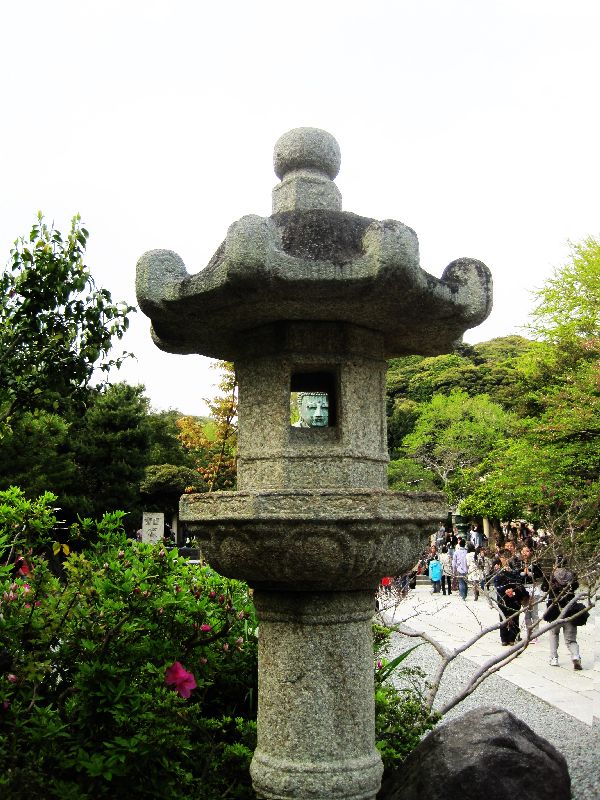
Buddha Buddies
(Asakusa)

Walking "home."
(Asakusa)

Samurai Masters
(Asakusa)

Tokyo Tower
(Minato)

Nothing like running into some classic Engrish. Sexy Fight!
Yes, that's a dude.
(Ueno Station)

Do you want your hotel room for 40 minutes or 60?
(Love Hotel Hill, Shibuya)

I have posted pictures of this building several times.
This picture I took myself, and it felt great to do it.
(Den-en-chōfu)

The temples of Kamakura are fantastic.
(Hase-dera Temple, Kamakura)

I have no desire to leave here ever.
(Hase-dera Temple, Kamakura)

Nothing in Japan is too serious to include some cuteness.
(Hase-dera Temple, Kamakura)

Can my backyard look like this someday? Please?
(Hase-dera Temple, Kamakura)

Poncho and his new BFF.
(Daibutsu AKA The Great Buddha, Kamakura)

Peek-a-Buddha, by Poncho
(Daibutsu AKA The Great Buddha, Kamakura)

Planning a Trip to Japan: Part 8

Friday, April 16, 2010

Part 8: Links, Links, and Links
As I stated at the start of this week, I've collected many, many links during my planning of this trip. Discarding repeats and not-useful things, these are a few of my favorite links.

General Travel Sites


General Japan Sites


Japan Blogs


Accommodations


Train Stuff
  • Japan Rail Pass - Also info on the six sub-companies and SUICA cards.
  • Hyperdia - Put in your starting point and destination, and receive route and price.


Things to See


Japanese Language


Random Articles I Like

Parts 1 & 2: Deciding When to Go and Buying a Plane Ticket
Parts 3 & 4: Trains?! and Deciding Where to Stay
Parts 5 & 6: What to Pack and To Do Between Now and Then
Part 7: Stuff I Wanna Do
Part 8: Links, Links, and Links

Planning a Trip to Japan: Parts 5 & 6

Wednesday, April 14, 2010

Part 5: What to Pack

Must have:
  1. Passport - This is your legal identification while in Japan; you're supposed to carry it at all times.
  2. Clothes - Don't be naked. You'll be sitting on the floor in some places so be sure your crack doesn't show. I always add +1 to my underwear count, just in case ("in case" of what, I'm not sure and I don't want to think about it). Layering is important, as the weather varies.
  3. Shoes - Be sure they're comfortable to walk in and slip on and off easily, as you'll be doing both a lot. Update: And be sure they won't let your feet get wet in the rain!
  4. Socks - Since you'll be taking your shoes off for traditional Japanese hotels, restaurants, and temples, be sure you have nice socks either on your feet or in your bag.
  5. Toiletries - Check to see what your hotel provides, and bring the rest. Don't get all stinky and gross on your vacation.
  6. Phrase book - I recommend Japanese at a Glance. It has a ton of information and the sections are color-coded. After I got it as a gift I was able to take three of my old books and put them away.
  7. Guides and maps - I spent a lot of time looking at the area maps on Japan Guide and printed a few pages for my own notebook. I also got the Knopf Mapguide for Tokyo. It's thin and has fold-out maps of each prefecture in Japan, as well as a list of interesting things in each area. The back has train and hotel information too.
  8. Camera - For the love of all that is holy, don't forget your camera. Take pictures like you know that as soon as you get home a piano will fall on you and give you amnesia. You can never have too many pictures of a trip.
Also recommended:
  1. Document copies - Leave a photocopy of your passport and credit cards with your main luggage, in case your real one gets lost or stolen. Also leave a photocopy back at home with someone reliable, like your mother.
  2. Entertainment - Don't forget a few small electronics or something to keep yourself entertained on that long flight. I'm bringing my Nook and Nintendo DS. Update: The personal entertainment centers on Korean Air were actually plenty to keep me entertained. I watched a lot of movies and played Tetris.
  3. Hankie/tissues - I hear most Japanese restrooms don't supply toilet paper, paper towels, or hand dryers. Most people dry their wet hands with a hankie, and carry a small pack of tissues for wiping. Businesses in the area also give out these packets of tissues in lieu of a plain flier. So I hear, at least. Update: Both of these rumors are true.
  4. Ear plugs - If you're sleeping dormitory-style, in case you run into a snorer.
  5. Journal - For most of my past trips, I just have pictures to remember things by. This time I will have my Tokyo moleskine to journal in. A small notebook would work too; I was lucky enough to receive the moleskine as a gift. Update: I mostly wrote in my other notebook and use my moleskine to press flowers.
  6. Medication - Airplanes are little more than airborne germ tubes, so pack some cold medicine. You probably also want some headache medicine, as Japanese over-the-counter drugs are weaker than American drugs. Be sure you pack them in their original packaging. I also hear condoms are smaller (ha) and more expensive in Japan. Update: They are totally, like, way smaller. Wow.
  7. Umbrella - It rains a lot in Japan. They sell umbrellas at the 100 yen stores though, if you want to risk it. Update: Our hotel had loaner umbrellas that were much nicer than the ones we brought. Though there were a couple of days where it was nice to have a small one in my purse instead of carrying around the big nice ones anyway.
  8. Gifts - You're supposed to give gifts in Japan. I'm going to bring a couple of American magazines for our ryokan's proprietors. Update: I gave them a Cosmopolitan and a Mad and it was awesome. They gave me candy, charms with our names carved in them, and a painting. Gifts are fun!
  9. Watch - If you're like me, you use your cell phone to tell time. Well, in Japan you won't have use of your cell phone. Bring a watch!
  10. Room for souvenirs - Don't pack your bag too full that you don't have room for souvenirs! I'm actually packing a bag that folds up really small in my main bag because I plan on buying many cute things. Update: I filled that whole extra bag to the brim. Shopping was glorious.
  11. Plastic bag - I always bring one when I travel to put my dirty laundry in.
  12. Security bag - Keep your passport and some cash in a security bag under your shirt. Japan is a relatively safe country, but there are always shady people around. Update: I felt fine not wearing one, with my passport and money in deep pockets in my messenger bag, which I kept close at all times.
On Japanese plugs and power: Plugs in Japan are the same as American two-prong plugs. They run at 100V, while Americans get 110V. That said, most American electronics should work just fine plugged into a Japanese outlet, but if you have something you cherish you may not want to plug it in, as something temperamental could be damaged. (More on electricity in Japan.)

Whether or not that sounds like a lot of stuff, all of my packing will fit in my pink gym bag and purse. I don't plan on checking any luggage, unless I fill up that extra souvenir bag, in which case I'll have to check that on the way back. If I can go to Oklahoma for three weeks without one carry on and a purse, I think one week in Japan with the same is reasonable.


Part 6: To Do Between Now and Then
  1. Get a passport. We just went down to the library one day and applied for them. It was easy, but it took a few weeks to arrive in the mail so don't put this off.
  2. Check with your bank about their international ATM use policy. My bank, for example, charges a $5 fee for overseas withdraws. Not all "cash machines" in Japan accept American cards; 7-11 ATMs, Japan Post, Citibank, and Shinsei bank do.
  3. Call or email your hotel to confirm your reservation. I did this immediately after making my reservation through the Welcome Inn Resource Center and again a week before traveling there, via email.
  4. Call your airline and pick where you're gonna sit on the plane. If you want and they let you.
  5. Buy yen.You can do this at your bank, a travel agent, the airport before you depart, or you can wait until you arrive at your destination. More on this below.
  6. Call your bank and credit card company to let them know you'll be overseas. Otherwise they will probably assume fraud and cut off your card.
  7. Fantasize about your awesome trip.
On buying yen:
If you search the Internet for exchange rates they'll give you a number, but you're not going to get that number. When I called my bank and demanded they justify this horrible meanness they said that the prices reported by the media are "corporate" exchange rates, but travelers get "retail" exchange rates. I guess that makes sense. It's still rude though.

I called our bank and they said they don't keep yen on hand, so it would take a day or two to complete the transaction. They charge a $7.50 flat fee for exchanges over $1000. When we went in they said, oh, by the way, it could take up to five days. Too freaking late! We're leaving in four days! And weekends don't count!

Oh well, should've done it a week in advance.

I called the American Express travel agency. They offered the same rate as the bank with a $7.00 flat fee for anyone, or a $5.00 flat fee for AmEx card holders. I told them "My traveling companion is a card holder, does he need to come in?" and they said "No, don't worry about it." I drove down there with the cash (if you use credit your card company will list it as a "cash advance" and charge you extra fees) and they handed over the yen. Oh, and, because I totally forgot about the $5.00 fee I was like $2.63 or something short and was so sorry and they just shrugged and said "It's fine." How fabulous is that?

For reference, today Yahoo! Finance was listing the exchange rate at 93 yen to the dollar, our bank was offering 88 yen to the dollar, so was American Express, and LAX was offering 82 yen to the dollar.


Parts 1 & 2: Deciding When to Go and Buying a Plane Ticket
Parts 3 & 4: Trains?! and Deciding Where to Stay
Parts 5 & 6: What to Pack and To Do Between Now and Then
Part 7: Stuff I Wanna Do
Part 8: Links, Links, and Links

Planning a Trip to Japan: Part 3 & 4

Tuesday, April 13, 2010

Part 3: Trains?!
Growing up in Southern California, I know little about public transportation. I took the Metrolink into Los Angeles for fun... once. When it was new. The notion of relying on trains and subways to get me around a foreign country tends to, frankly, freak me the hell out, and so I've poured a considerable amount of effort into reading about public transportation in Japan.

Firstly, I have been reassured many times and by many people that it's really not that difficult, that it's super efficient, and that just about everything's in English anyway. So that's good.

Every site I read tells me all about rail passes. There are a ton of options for rail passes: day passes, prepaid cards, and even passes that only tourists can get for unlimited use on trains around the country.

The most useful information I found was through Japan Guide's articles on transportation and taking the train. They list all of the rail passes and such and such. Lonely Planet has a pretty good article too. After doing some reading, if you're still confused, make a post on their forum and you'll get quick and clear answers.

Basically, as I see it, you have four options:
1) Japan Rail Pass - 28,000¥ for 7 days of unlimited train travel around the country; valid for most lines but not all
2) A Region-based JR Pass (just one of the colors) - If you're just going to be in one region then you can get a pass just for that region, which is cheaper than buying one that would take you all over the country.
3) A SUICA card - If you're just going to be in, say, one city, you probably don't need a big fancy rail pass. A SUICA card is a pre-paid card accepted at most train stations, subway stations, and I hear bus stations. And vending machines! (Note: Under "Using Your SUICA Card" you can find a map in .pdf format of all the stations that accept SUICA cards. I printed it and put it in my notebook.)
4) Wing it - You know, if you want. There are day passes and stuff. I suppose this would be fine if you just don't want to fret about it or are really staying in one place.

Taxis are expensive; avoid them.

Another great site to keep handy is Hyperdia.com. You can put in your starting point and destination and it'll give your the route, time, and cost. I used this to help me determine whether or not I would actually get my money's worth out of the different types of passes.

My results: We are going to get SUICA cards when we arrive in Narita. We are staying in Tokyo the full week, except one day, when we'll travel down to Kamakura, which'll cost us about $20. I don't think we'd get our money's worth out of a JR Pass unless we did more traveling, but we're mostly satisfied with what Tokyo has to offer.

Update: We didn't even bother with SUICA cards. I suppose we could have. Just like everyone says, it took us a couple of days to get used to the system but then we had it pretty much down. A lot of people did have SUICA cards, which seemed to make things go quicker for them, but we didn't have a problem just buying tickets as we needed them. Just be sure you have a good map of the lines to see how they connect and where, especially since some station maps are only in kanji. A couple of times the exit gates spit our tickets back out, indicating that we owed more money, but then you just walk to the end where there's the dude at the window, and he tells you what you owe. No big deal.

Part 4: Deciding Where to Stay
The options for where to stay are ridiculous. It can be overwhelming to start, but if you break up your priorities you can narrow it down pretty easily.

Types of accommodations in Japan:
1) Western-style Hotel - These are standard hotels with standard rooms and if you stay in one of these then sad for you! Why would you go all the way to Japan to sleep in a Holiday Inn? This is also not the cheapest option, though, I admit, I had no real interest in looking into Western-style anything.
Links: Welcome Inn Reservation Center, JAPANiCAN


2) Capsule Hotel - Pictured to the left, a capsule hotel is basically sleeping in a little box with a little TV. A unique Japan experience, and an economical choice. Many have a males-only policy, but I found plenty that allow females.
Links: Welcome Inn Reservation Center, JAPANiCAN

3) Ryokan - A traditional Japanese inn with tatami floors and futons and furo baths, oh my! Usually family-owned, there are a ton of these around for lots of different prices.
Links: Japanese Guest House, Welcome Inn Reservation Center, JAPANiCAN

4) Gaijin Houses/Hotels/Dorms - These are the cheap options. A lot of them offer very few amenities (bring your own towel!) and you sleep in bunks with other people. But, hey, I saw beds as low as 1,400 yen for a night and the people are usually friendly. Sounds like a great way to meet other travelers too.
Links: Gaijin House Japan, Hostel World, Welcome Inn Reservation Center, JAPANiCAN

5) Love Hotels - Find a hotel with almost any theme and rent a room by the hour. Best part: you never have to see an employee. You pick a room from a light-up board, pay, and get your key.

Confession! I only listed what I think are the best options. If you want to see a few more, you can read about them here.

 Whichever you choose, be sure to also check Trip Advisor! After I had narrowed our choices down to two places I looked them up on Trip Advisor and one of them had a handful of reviews that said they had bed bugs from 2007 up until a few months ago. Not risking it! Gross.

My results: The most appealing option out of the above, to us, was the ryokan. We wanted something traditionally Japanese and found many options within our price range of $100 per person per night. For decent environment and prices, I recommend staying in the Taitō prefecture, in either Ueno or Asakusa.

Our main resource for finding accommodation  was the Welcome Inn Resource Center, as they seemed to have the best selection. We also booked through them, and I have confirmed that our ryokan has that reservation on file. Through them we got a good price on a room at the Sukeroku No Yado Sadachiyo, which is right near a five-story pagoda. That's the front of it in the picture.

Update: And it was amazing. When I go to Japan again (that's a when, not an if) I will be very torn on whether I want to try staying some place new, or whether I want to stay again at Sadachiyo, for I loved it ever-so much.

Parts 1 & 2: Deciding When to Go and Buying a Plane Ticket
Parts 3 & 4: Trains?! and Deciding Where to Stay
Parts 5 & 6: What to Pack and To Do Between Now and Then
Part 7: Stuff I Wanna Do
Part 8: Links, Links, and Links


Planning a Trip to Japan: Part 1 & 2

Monday, April 12, 2010

Introduction
I originally started this blog in order to keep myself motivated and pursue all my travel dreams. As such, Poncho and I are hopping on a flight to Japan this Sunday.

Hurrah!

Planning a trip overseas is a lot of work. I'm sure I have well over one hundred bookmarks for this in a couple dozen folders. Here I will lay out my planning strategy, along with helpful links, and hopefully it'll be useful for others to use as a skeleton to plan their trips.
Part 1: Deciding When to Go
1) Japan has four distinct seasons. Which one sounds most awesome?
  • Winter - Christmas, snow
  • Spring - cherry blossoms (March/April), mild weather
  • Summer - rainy season (June/July), beach weather (July/August)
  • Fall - beautiful foliage
2) Times to maybe avoid (unless you particularly want to see these things, of course):
  • Golden Week - Usually end of April to around May 5th, Japan has three holidays and this week is a very busy travel time for locals. As such, airports, trains, and hotels are very busy, and many local business are closed.
  • Obon- August 13 to 16 is another holiday and busy travel time for locals.
  • New Years, the April/March cusp (school break), and the July/August cusp (school break) may also be times to avoid.
  • Rainy season! From the beginning of June to mid-July.
  • September is typhoon season.
3)  See if there's anything in particular you want to see while you're there. I, for example, specifically chose to go during cherry blossom season. See if there are any festivals that interest you. The Kanamara Matsuri (fertility festival; think giant weenies) on the first Sunday of April is a favorite.

My results: I decided to go during the Spring because trees covered in pink are of great interest to me. The earliest Poncho could get off was the third week of April. He only gets five vacation days so we can only go for that week. Between the twelve-hour flight and seventeen hour time change we lose a day. Considering all that, we booked our flights for Sunday, April 18 and returning on Sunday, April 25.


Part 2: Buying a Plane Ticket
For an international trip you should probably buy your tickets at least a month in advance. We bought ours two months in advance and our friend bought a ticket to join us a month later for the same price. Right now the same tickets are $100 more. Though I can't imagine many people would wait until the last minute to get a plane ticket to another continent...

You'll probably fly into Narita Airport, as they handle most of Japan's international flights. Haneda Airport is closer to Tokyo, but you'll probably go to Narita anyway. (Note: We're only planning to go to the Kanto region (Tokyo area) so you may go to a different airport if you were to be traveling to, say, Hokkaido.)

I hear it's good to book directly through the airline when you can. When I went to Oklahoma I got the best rate directly through Southwest Airlines. Obviously Southwest doesn't have flights to Japan, so we went with our other method: HotWire.com. We also used them to go to Hawaii and Jamaica and it's been fine. I like their search tools.

After you've decided on a flight, either before or after you actually buy it, check out SeatGuru.com to see what your plane is going to be like, and call the airline to request a seat. They might say you have to wait until you actually check in or something, but it's worth a shot.

My results: We got tickets through HotWire on Korean Airlines for a direct flight to Narita, Japan for $755 each. I looked up our plane on SeatGuru.com and was pleased to find out each seat has its own plug, so I can keep my Nintendo DS charged. I then called the airline and asked them if my husband, our friend, and I would be able to sit together since we booked out tickets separately, and she happily gave us three seats with a window.

Parts 1 & 2: Deciding When to Go and Buying a Plane Ticket
Parts 3 & 4: Trains?! and Deciding Where to Stay
Parts 5 & 6: What to Pack and To Do Between Now and Then
Part 7: Stuff I Wanna Do
Part 8: Links, Links, and Links
Related Posts Plugin for WordPress, Blogger...